Madison Bressler: Style
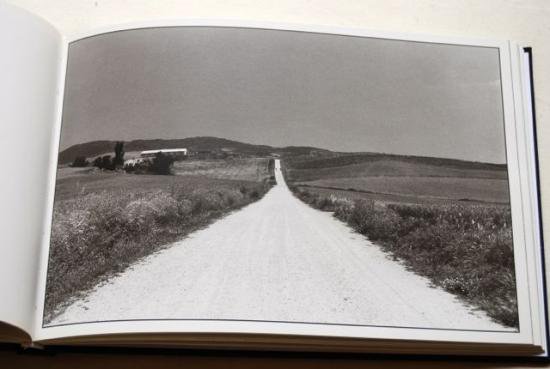
Hamish Fulton: The Way to the Mountains Starts Here
Hamish Fulton was born in London in 1946, and he is currently 73 years old. He attended Hammersmith College of Art, Martin's School of Art, and the Royal College of Art. Fulton is identified as a walking artist, which means his only work is based on his experiences while taking walks. In a gallery setting, he utilizes photographs, illustrations, and vinyl wall text to demonstrate his walks to his viewers. Fulton's style focuses on the path being walked on. Most of his photos feature a long path in the center that disappears into the infinite distance. Others strictly show the ground in from of the photographer. All of the photos are in some way pictures that one would see while taking a walk, whether it be on a road or a path. His photos are in the landscape orientation, and they are in black and white. There is very little inclusion of human and animal forms, because his pictures mainly show earth-like subjects and landscapes. He likely uses a high aperture since all parts of his photos are in focus. The perspective of his photos seems to be from eye-level, as if in a way one would see while walking themselves.
Wim Wenders: Places, strange and quiet
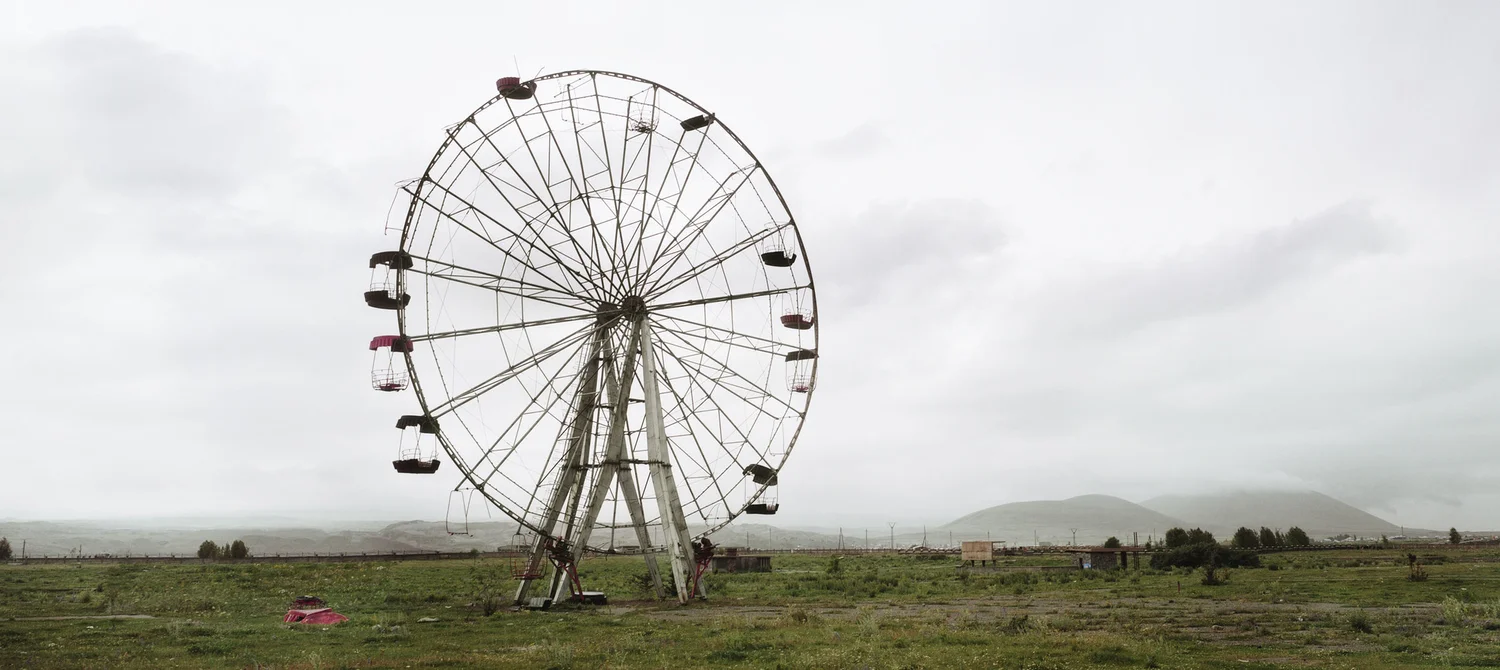
Ernst Wilhelm Wenders was born in 1967 in Germany. He is a filmmaker, director, screenwriter, author, playwright, and, most importantly, a photographer. He is most notably known for his films, in which he has won four prestigious awards, along with being the president of the European Film Academy. His photography focuses on landscapes and specific places. Many of his photos are much wider than they are tall, and this gives the effect of a more expansive landscape. His camera settings often allowed all parts of the photograph to be in focus (i.e. a high number aperture). His style also portrayed the exposure of the photographs to match real life. Some photographers prefer to under or over-expose the overall image, but Wenders did not do that. His photos, also, include a lot of color. As the title of his book implies, Wenders photographed places that were, many times, free of people and places that one would not normally photograph or see in general. Many of these locations appear to have a small population of regular traffic by people, and many look abandoned completely. Overall, Wim Wenders focused on photographing unusual places in a way that properly represented how he saw them.
https://www.doobybrain.com/blog/2016/3/8/wim-wenders-places-strange-and
Bohumil Krcil: Fototorst

Bohumil Krcil: Fototorst
Bohumil Krcil was born in Czechoslovakia but quickly became an exile when he left at age 17 with his camera. He traveled through Europe and Asia for 23 years and ended up in Manhattan. His book, published in 2007 after his death in 1992, is a documentary-portrait series that shows the combination of cultures in different continents at different time periods. Krcil does not seem to have as specific of a style as the last two photographers, because he photographed many different subjects in different places and stages of his life. Since the photos in the book are spread over a span of 11 years, it is hard to pinpoint any distinct style among every single one of his photos. Most of his photos are in black and white, with exception of his pictures from 1979 in India. He, often, took portraits of people in which the subjects are looking directly into the camera or are posed. Krcil focused a lot on the effect of light in an image. Many of them seem dark or underexposed. He utilizes light to illuminate specific parts of a subject that he wants to focus on. In some cases, the light can even create the subject.


Comments
Post a Comment