Katie Martin Style
Style Paragraphs Katie Martin
- Fergus Greer
Similar to Richard Avedon, Fergus Greer was in the military for four years and decided to leave in order to pursue photography professionally. He also was a photographic assistant for Richard Avedon, which may explain why there are many similarities in their styles. Greer uses backdrops for his unique portraits, but the backdrops are special in that they are very textured and often the subject interacts with the different materials. He also uses bright white or dark black backgrounds which allow the viewer to focus more on the subject with the added contrast. The subject in Greer’s photos are always dressed in extravagant outfits and very artistic poses. He either uses drastic shadows or has a very well lit photo without any shadows. The images commonly have a geometric shape taking over the image created by the clothing. Greer’s reason for photographing Leigh Bowery was to capture the weirdness of him and his style. The clothing is the focus of all of his photos, not the face. His photographs are pretty evenly split between color and monochrome. He photographed Leigh Bowery over the course of six years. His photos also show that there is a relationship between Greer and Bowery and they exude confidence.

- Mark Edward Harris
Mark Edward Harris started off his professional career by doing stills for the Merv Griffin Show, but soon after the show ended he began his traveling journey. He has photographed over 100 countries. The book I checked out is split into 5 sections: Asia, Africa, Europe, North America and South America. His photos focus more on the people than the place, though. There are many different types of portraits. Harris uses a lot of different cameras- most of them Nikon. All his photos in this book are monochrome. Unless he is doing a landscape image (which are more rare), he uses a shallow depth of field. He tends to photograph people in their everyday lives. His images are split between portraits where the subject is participating in the photo and also environmental portraits where there are multiple subjects who are not looking at the camera and there is more of a focus on the buildings and nature that frame them. He most commonly uses angles that make the viewer feel like they are standing in the place he was and looking in, however there are a handful of photos that are from high and low angles. When he photographs a single person, he definitely gives them space in his framing, but when he photographs groups, it is not unusual for him to crop some people in half. He has some action shots, but they do not show motion. His photos are mostly vertical, but he also photographs horizontally when he is capturing a group or for most of his landscapes. The lighting is almost always natural, and feels natural even when it is indoors. There is never any harsh lighting or dramatic shadows. The thing that makes Harris’ photos unique is probably the simplicity of his photos and the relationship he has with those he photographs (even when he doesn't seem to know them).

- Richard Benson
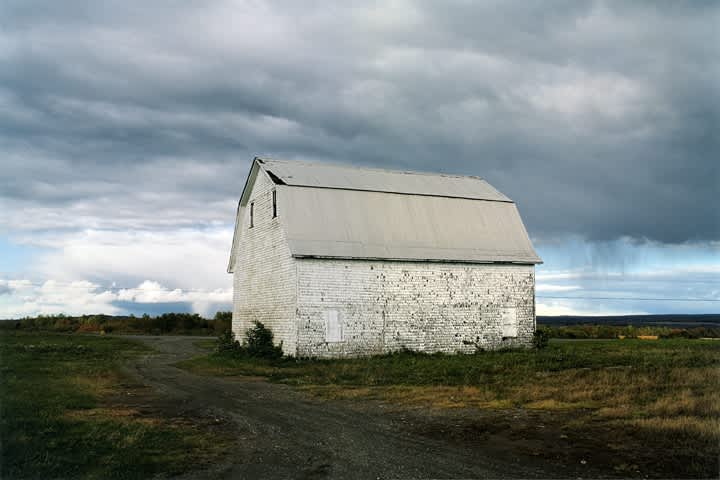
The former dean of Yale School of Art, Richard Benson is known for his very vibrant prints. He is a landscape photographer and focuses a lot on color. His images have a lot of saturation. Benson is particularly interested in scrap machinery. To make a lot of his photographs, he would drive down the highway and wait until something caught his eye. All his photos include something man-made (usually something kind of run down) with nature as well, which creates a cool dynamic. I see a pattern in his photos- usually it seems like he is capturing something that almost seems like it is out of place. He also likes to photograph houses- especially ones that are painted unusual colors. It is common for his photos to be capturing a main shape or a pattern of smaller shapes- especially when he photographs storefronts. Richard Benson uses the technique that we learned that adds depth to his photos. When photographing buildings especially, he photographs at an angle instead of using a wall as a sort of backdrop. The one exception to this is when he photographs doors or graffiti on stones. Benson started photographing in the 60’s with an 8 x 10 view camera but has since embraced new digital technology. The relationship he has with both new technology and old technology reminds me of the relationship between objects and nature in his photos. The thing that makes Richard Benson’s photos unique is how every photo feels like he has stumbled across something that doesn't belong there. His interest in printing also shows through because the photos are very crisp and saturated in the book.


Comments
Post a Comment